Sunset times in the Bahamas: sunrise, daylight and golden hour by month
Sunrise and sunset times in the Bahamas month by month, Eastern Time and daylight saving, golden hour in the tropics, and where to watch the sun go down.

Hannah Lowe · 9 min read
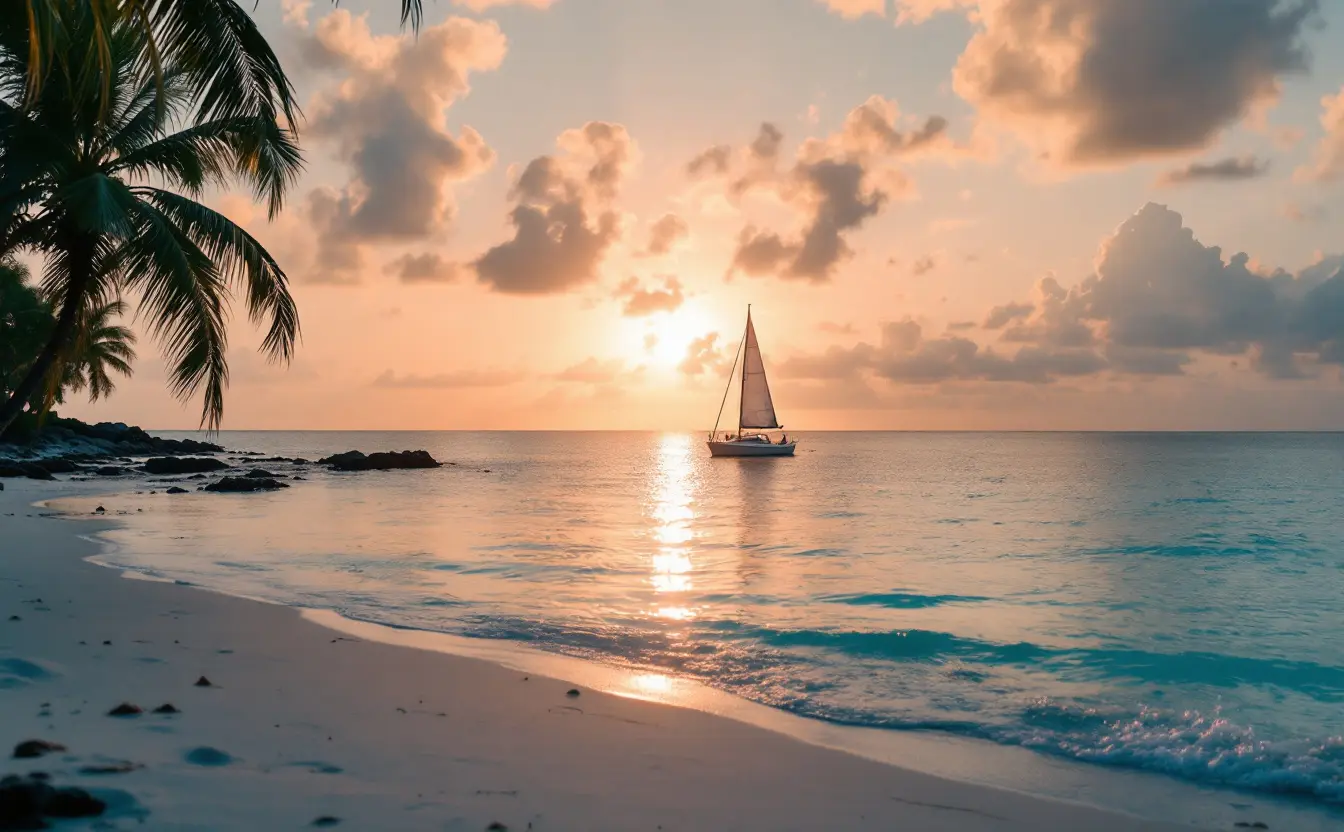
In the settlement on Abaco where I grew up, sunset was close to a public event. The boats came in, the porches filled, and somebody always had an opinion on whether the green flash had shown or not. In Nassau the ritual survives, with more traffic. People pull over on West Bay Street, phones come out, and for a few minutes the whole north shore turns the colour of a ripe mango.
This guide gives sunrise and sunset times through the year, explains the time zone and daylight saving, and covers golden hour, which is shorter here than most visitors expect, and the kinds of places to watch from. All times were worked out with the method behind the NOAA solar calculator and rounded to the nearest minute. They vary by island, and different calculators can disagree by a minute or so. For any date and island, our sunrise and sunset planner does the sums for you.
Time zone and daylight saving
Every island in the Bahamas keeps Eastern Time, the same clock as Miami and New York. In winter that is Eastern Standard Time, five hours behind UTC. From the second Sunday in March to the first Sunday in November the country moves to Eastern Daylight Time, four hours behind UTC, on exactly the same dates as the United States.
The clocks went back on 1 November 2026. They go forward again on 14 March 2027 and back on 7 November 2027. If you are flying in from Florida or the north-east of the United States, your phone will not change at all.
Daylight saving explains the shape of the year here. Summer evenings are long, with the sun setting after 8 pm in late June. Winter evenings are short, with sunset before half past five from early November to late December. And the jump in March is sudden: in 2027 the sun sets at about 6:17 pm on 13 March and about 7:18 pm on 14 March.
Nassau, month by month
Times for the 15th of each month in Nassau, on the clock in use that day:
| Month | Sunrise | Sunset | Daylight |
|---|---|---|---|
| January | 6:56 am | 5:42 pm | 10 h 45 min |
| February | 6:44 am | 6:04 pm | 11 h 20 min |
| March | 7:18 am | 7:18 pm | 12 h 00 min |
| April | 6:47 am | 7:32 pm | 12 h 45 min |
| May | 6:25 am | 7:47 pm | 13 h 22 min |
| June | 6:19 am | 8:01 pm | 13 h 41 min |
| July | 6:29 am | 8:02 pm | 13 h 33 min |
| August | 6:43 am | 7:44 pm | 13 h 01 min |
| September | 6:55 am | 7:13 pm | 12 h 18 min |
| October | 7:08 am | 6:42 pm | 11 h 35 min |
| November | 6:26 am | 5:22 pm | 10 h 56 min |
| December | 6:47 am | 5:22 pm | 10 h 36 min |
A few moments in the year stand out:
- Latest sunsets: about 8:03 pm, from around 23 June into the second week of July.
- Earliest sunsets: about 5:19 pm, from about 25 November to the first days of December. That is roughly three weeks before the shortest day, because solar noon drifts later through December, so sunsets start getting later again while the days are still shrinking.
- Earliest sunrises: about 6:19 am, through the first half of June.
- Latest sunrises: about 7:20 am, or 7:25 am when the change falls as early as 8 March, just after the clocks go forward. The last mornings before the clocks go back in November come close, at about 7:15 to 7:20 am. In midwinter the latest is about 6:56 am in early January.
- Longest and shortest days: about 13 hours 42 minutes around the June solstice and 10 hours 35 minutes around the December solstice. The difference is only a little over three hours, far gentler than in New York or London.
How the times change from island to island
The Bahamas stretches a long way, from Bimini, on the edge of the Gulf Stream, to Inagua, close to Cuba and Haiti. That shows up in the clock. Here are times for the 15th of June and the 15th of December:
| Place | June sunrise | June sunset | December sunrise | December sunset |
|---|---|---|---|---|
| Alice Town, Bimini | 6:26 am | 8:10 pm | 6:56 am | 5:29 pm |
| Freeport, Grand Bahama | 6:21 am | 8:09 pm | 6:55 am | 5:25 pm |
| Nassau, New Providence | 6:19 am | 8:01 pm | 6:47 am | 5:22 pm |
| George Town, Exuma | 6:16 am | 7:51 pm | 6:37 am | 5:19 pm |
| Matthew Town, Inagua | 6:13 am | 7:37 pm | 6:24 am | 5:16 pm |
Two things are at work. The first is longitude. Inagua lies more than five degrees of longitude east of Bimini, and the sun crosses a degree every four minutes, so everything happens about 22 minutes earlier there, all else being equal. The second is latitude. The northern islands get longer days in summer and shorter ones in winter.
In June, both effects push Inagua's evening earlier, so the sun sets there about half an hour before it does in Bimini. In December the two effects partly cancel, and the gap in sunset shrinks to about a quarter of an hour. Sunrise works the other way round: about 13 minutes apart in June, about half an hour in December. That matters if you are flying between islands, because most Family Island airports operate from sunrise to sunset; our guide to island-hopping the Exumas covers the planes, ferries and mail boats.
Golden hour and twilight in the tropics
Golden hour has no official definition. Photographers usually mean the time when the sun is low, within about six degrees of the horizon, and the light turns warm and soft. That is the edge our planner uses too.
The surprise for visitors is how short it is. Near the tropics the sun drops almost straight down towards the horizon rather than sliding along it, so in Nassau it takes only about half an hour to go from six degrees up to sunset, at any time of year. In New York the same stretch of light lasts roughly 35 to 45 minutes, and in London from 45 minutes to an hour.
Twilight is short too. Civil twilight, the period after sunset when there is still enough light to see by outdoors, lasts about 23 to 26 minutes in Nassau. Half an hour after sunset it is properly getting dark.
In practice:
- Arrive early. Be in place about 45 minutes before sunset, or you will miss most of the warm light.
- Stay a little after. The sky often colours best 10 to 15 minutes after the sun has gone.
- Carry a torch. If you are walking back along a beach, a bush track or a rocky shore, you will need it sooner than you think.
- Try the morning. Morning golden hour is just as short but usually calmer and cooler, with glassy water and empty beaches.
Where to watch the sun go down
The sun does not set in the same place all year. In late June it goes down about 26 degrees north of due west; in late December, about 26 degrees south of west; at the equinoxes in March and September, due west. A beach facing north catches the sun setting over the sea in the summer months, but in winter it may drop behind the land. A shore facing west gets it all year.
That gives a few rules of thumb:
- New Providence. The north shore west of downtown has sunsets over the water from spring into early autumn. The western end of the island faces the right way all year.
- The Exumas. The cays have two sides. The western, bank side looks over the shallow Great Bahama Bank, where calm, pale water reflects the colour back. The eastern side faces the deep water of Exuma Sound and is the place for sunrise.
- Eleuthera and Long Island. Both have a sheltered western coast for sunset and an Atlantic coast for sunrise. On Harbour Island, the pink-sand beach faces east, so it is a sunrise beach.
- Bimini. The western shore looks out over open sea towards the Gulf Stream, with nothing between you and the horizon.
The green flash. On a very clear evening, with a sharp sea horizon and no cloud bank, the last sliver of sun can flash green for a second or two. A west-facing shore over open water gives you the best chance; a hazy summer evening rarely shows it. Never look at the sun through binoculars or a camera viewfinder while it is above the horizon.
The season changes the show. Summer evenings bring towering clouds that catch pink and orange light long after sunset. Winter brings the clearest air of the year, especially a day or two after a cold front has passed, with crisp horizons and the best odds of a green flash. Our month-by-month weather guide explains how fronts and summer storms come and go.
One last practical note: on still evenings near mangroves and salt ponds, sandflies and mosquitoes come out as the light fades. Bring repellent, and a long-sleeved layer, for any sunset plan.
Frequently asked questions
What time is sunset in the Bahamas?
In Nassau it ranges from about 5:19 pm in late November and early December to about 8:03 pm from late June into early July. The southern islands see the sun go down earlier than Nassau, and Bimini and Grand Bahama later. Our planner gives the time for any date and island.
Is the Bahamas on the same time as Florida?
Yes. The whole country keeps Eastern Time, the same as Florida and New York, and changes its clocks on the same dates. Travellers from the eastern United States do not need to change their watches.
Does the Bahamas have daylight saving time?
Yes. Clocks go forward an hour on the second Sunday in March and back on the first Sunday in November, the same dates as in the United States. In 2027 that means 14 March and 7 November.
When is golden hour in Nassau?
Roughly the last half hour before sunset and the first half hour after sunrise. Because the sun drops steeply this close to the tropics, it is shorter than in North America or Europe, so arrive about 45 minutes before sunset.
Where is the best place to watch the sunset in the Bahamas?
Any shore facing west over open or shallow water works all year, such as the western end of New Providence, the bank side of the Exuma Cays, the western coasts of Eleuthera and Long Island, or Bimini's western shore. North-facing beaches catch the sun over the sea mainly between spring and early autumn.
Keep reading
Snorkel gear for kids in the Bahamas: masks, vests, fins and safety
Snorkel gear for kids in the Bahamas: fitting a mask to a small face, dry-top snorkels, fins, vests, rash guards and the supervision that matters most.
Snorkel gear for a Bahamas trip: masks, snorkels and fins that travel
Snorkel gear for a Bahamas trip: how to fit a mask, dry-top or classic snorkels, short travel fins, kids' sets, vests and keeping the glass from fogging.
Reef-safe sunscreen for the Bahamas: labels, ingredients and how much
Reef-safe sunscreen for a Bahamas trip: what the label does and does not promise, which filters people avoid, how much to pack and when to reapply.