Bahamas plug type and voltage: adapters, chargers and power on the cays
Bahamian sockets take US plugs at 120 volts and 60 Hz. What US, Canadian, UK and EU visitors need, plus charging on boats, small cays and cruise ships.

Devon Saunders · 9 min read
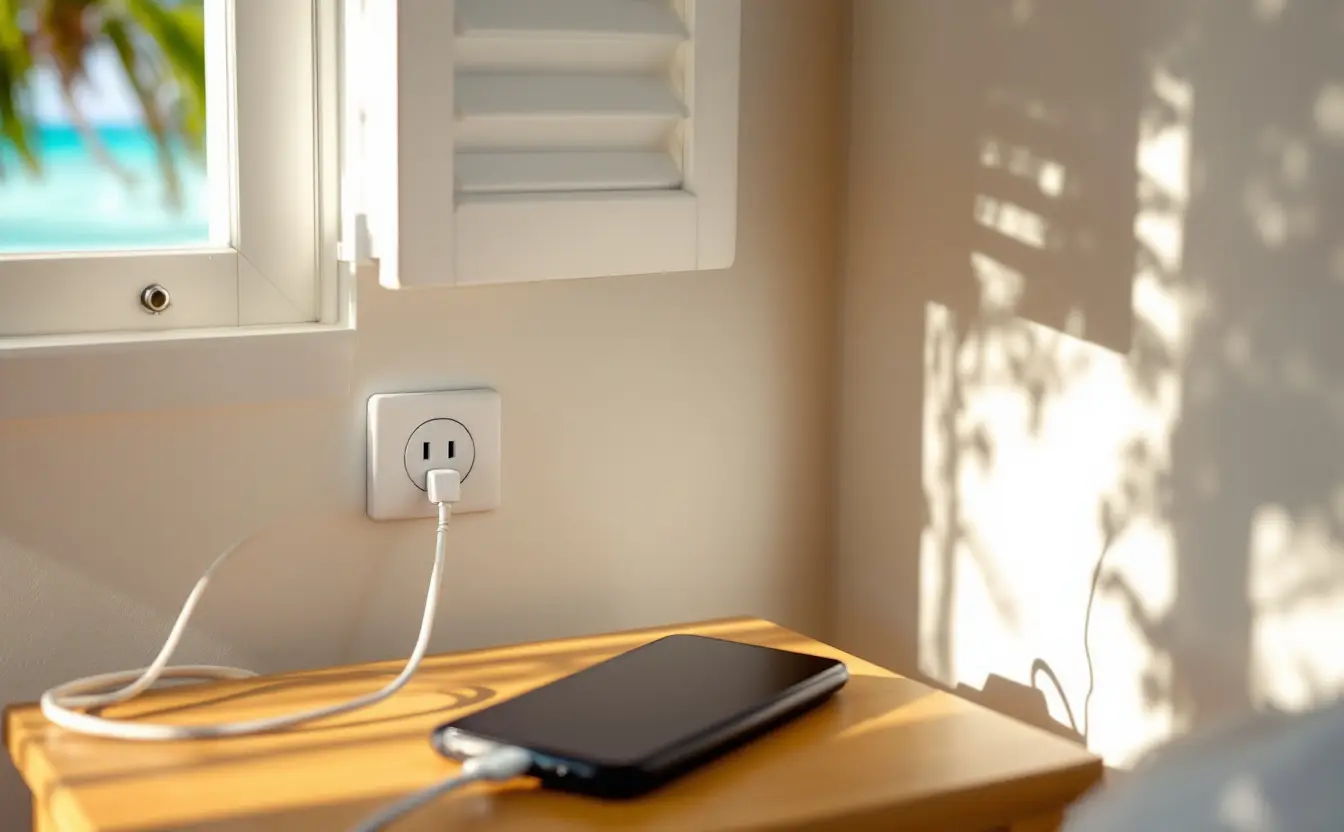
The plug question tends to arrive a week before departure, usually from someone flying in from London or Frankfurt. The answer is short. Bahamian sockets are the same as those in the United States and Canada: plug types A and B, running at 120 volts and 60 hertz. The Ministry of Tourism's visitor FAQ describes the outlets as 60 cycles and 120 volts, compatible with American devices.
Island-ready picks
- Browse on Amazon
UK-to-US plug adapter
Bahamian sockets take US plugs; this lets UK plugs fit
Price at Amazon, 19 Oct 2026, 12:35 am: $13.99
- Browse on Amazon
Slim 10,000 mAh power bank
A day of maps and photos away from a socket
Price at Amazon, 19 Oct 2026, 12:35 am: $20.89
- Browse on Amazon
Waterproof phone pouch on a lanyard
Photos from the dinghy without risking the phone
Price at Amazon, 19 Oct 2026, 12:35 am: $11.99


CheapOair flight search A second place to compare flights to Nassau and the Family Islands
Continue to CheapOairProduct prices and availability are accurate as of the date/time indicated and are subject to change.
That shared standard makes sense once you follow the trade. Most visitors come from North America, and most of what Bahamian shops sell, from fridges to phone chargers, arrives by sea from Florida. Hotels, rental homes and offices are wired for the plugs those visitors and goods carry.
This guide covers what that means for travellers from different countries, which devices need a closer look, and how to keep a phone alive on a boat, a small cay or a cruise ship. It is practical information, not electrical advice. If you are unsure about a particular appliance, its label and its maker have the final word.
The short answer by home country
| Where you live | Plug at home | Adapter needed? | What to check |
|---|---|---|---|
| United States | Types A and B | No | Nothing for most devices |
| Canada | Types A and B | No | Nothing for most devices |
| United Kingdom | Type G, three rectangular pins | Yes, UK to US | The input rating on every charger and appliance |
| Most of the EU | Types C, E or F, round pins | Yes, EU to US | The input rating on every charger and appliance |
| Elsewhere | Varies | Usually | Every charger and appliance |
Visitors from the US and Canada can stop reading here, unless they are heading to a small cay, a boat or a cruise ship, where the sockets are not the issue so much as finding one at all. Those sections are further down.
Types A and B, explained
Type A is the flat two-pin plug found on most phone chargers and small electronics in North America. Type B adds a round earth pin below the two flat ones and is used on laptops, kitchen appliances and anything with a metal case.
A type B socket accepts both plugs. A type A socket has only the two slots, so a three-pin plug will not go in. Both kinds turn up in the Bahamas, and the two-slot sort is more likely in older buildings. A charger with a two-pin plug, or a laptop power brick with a detachable lead, gets round the problem. Never snap off or bypass an earth pin to make a plug fit. It is there for a reason.
Voltage: the part an adapter does not change
A plug adapter changes the shape of the plug and nothing else. The UK and continental Europe run at around 230 volts and 50 hertz. The Bahamas runs at 120 volts and 60 hertz. Whether a device copes with that difference depends on how it was built, not on the adapter.
Look at the small print on the charger or on the base of the appliance. A line such as "INPUT: 100-240V 50/60Hz" means the device is dual voltage: it adjusts itself and needs only a plug adapter. Almost all phone, tablet, laptop and camera chargers are made this way, because their makers sell them worldwide. Electric toothbrush and shaver chargers vary, so check each one.
The usual problems are heating appliances: hair dryers, straighteners, curling tongs and travel kettles bought in Britain or Europe are often built for 230 volts only. On 120 volts they run weakly or not at all. A step-up converter can power them, but converters big enough for a hair dryer are heavy, and the simpler plan is to leave these at home. Many hotels provide a hair dryer in the room; ask before you pack.
The difference between 50 and 60 hertz rarely matters for chargers. It can affect devices with motors or clocks that keep time from the mains supply, which may run at a different speed. Battery-powered gadgets do not care.
What each visitor needs
From the United States
Nothing beyond your usual chargers. The plugs, voltage and frequency match. A multi-port USB charger is still worth packing, because hotel rooms rarely have as many free sockets as a family has phones.
From Canada
The same as the US. Canadian plugs and voltage are identical to Bahamian ones.
From the United Kingdom
A UK to US plug adapter for each device you want to charge at the same time, or one adapter feeding a USB charger with several ports. Read the input rating on everything electrical before it goes in the case. Leave single-voltage straighteners and hair dryers behind unless you are prepared to carry a converter.
From the EU and elsewhere
An adapter that takes your plug and fits a US socket. Round European pins will not go into flat-slot Bahamian sockets. Many "universal" travel adapters include US pins, which is fine, but check before relying on one. Australian, New Zealand and South African visitors need the same voltage checks as Europeans.
Hotels, rentals and older buildings
Hotel rooms in Nassau and on Paradise Island are wired to the same standard as an American hotel, and some newer rooms add USB ports in lamps or wall plates. Older cottages, guest houses and some Family Island rentals may have fewer sockets, two-slot outlets only, or a single socket behind the bed. A short USB cable and a charger with several ports solve most of this.
If you are renting a house, ask the host what is provided. Some keep a drawer of adapters and torches left by previous guests. A few minutes on the phone before arrival is cheaper than hunting for a hardware store on a Sunday.
Power on the Family Islands and small cays
New Providence, Grand Bahama and the larger Family Islands run on public grids, and the sockets work exactly as they do in Nassau. Supply is the variable. Power cuts happen on every island from time to time, and after a storm they can last a while. The president of the Bahamas Hotel and Tourism Association has said that many small Family Island hotels cannot supply all of their own power when the public supply fails, and more island hotels are adding solar panels, batteries and diesel back-up to generate some of their own.
For a visitor, that means a few habits:
- Charge when you can. Top up phones and power banks overnight and whenever you are back in the room, not when the battery is already low.
- Pack a torch or headlamp. A dark cottage during an outage is no place to hunt for a phone.
- Ask about the generator. On private cays and at small lodges, ask whether power runs all night or whether the generator is switched off at certain hours.
- Keep the fridge shut. If you are self-catering and the power goes, an unopened fridge stays cold for hours.
Our first-timer's guide to the Out Islands explains how different each island is, and residents' own approach to outages in storm season is in the hurricane-season household calendar.
Charging on boats and day trips
The Exumas and the Abaco cays are best seen from the water, and boat days are where phones run flat. Small open boats, the kind used for snorkelling trips and water taxis, have no sockets at all. Larger charter boats and catamarans may have USB points or a 12-volt socket running from the boat's batteries, but the captain's priority is the engines, the radio and the navigation lights, not your camera. On a mail boat or a long ferry crossing, do not count on finding a free socket. Our guide to island-hopping the Exumas gives a sense of how long those days can be.
A slim power bank in a dry bag covers a full day. Keep both out of direct sun on deck, because phones and batteries both dislike heat. If you fly between islands, remember that spare lithium batteries, power banks included, belong in hand luggage, not in checked bags. The same rule applies on small domestic planes and charter flights.
Cruise cabins
Most Bahamas cruises sail from Florida on ships built for American passengers, and cabins on those ships usually have US-style sockets. Many newer ships add European-style sockets alongside them. The bigger question is what you may plug in. Cruise lines ban surge protectors, after a US Coast Guard safety alert warned that devices designed for land-based wiring can be a fire risk on ships. Some lines go further and ban power strips and multi-socket adapters of any kind, while allowing USB-only charging blocks. Rules differ by line and change from time to time, so read your line's list of prohibited items before you pack, because banned items may be held by security until the end of the voyage.
A modest power kit
For most trips, three things are enough: an adapter if you are coming from outside North America, a power bank for boat days, and something waterproof to carry it in.
Shore bag
- UK-to-US plug adapterBahamian sockets take US plugs; this lets UK plugs fitBrowse on Amazon
- Slim 10,000 mAh power bankA day of maps and photos away from a socketBrowse on Amazon
- Roll-top dry bag, about 10 litresPhone, keys and a towel stay dry on boat days and wet landingsBrowse on Amazon
These three were chosen from makers' specifications and published reviews; we have not tested them ourselves. Read the input rating and capacity on whatever you buy, and pack the power bank in your hand luggage.
Before you pack: a power checklist
- Read the input rating on every charger and appliance.
- UK and EU visitors: one adapter per device you plan to charge overnight, or one adapter and a multi-port USB charger.
- Leave single-voltage heating appliances at home and ask whether the room has a hair dryer.
- Charge a power bank before you leave and carry it in your cabin bag.
- On the Family Islands, add a torch or headlamp.
- For cruises, check your line's rules on power strips and adapters.
Our packing list planner builds the rest of the bag around your dates and islands.
Frequently asked questions
Do I need a plug adapter in the Bahamas?
Not if you live in the United States or Canada, since Bahamian sockets take the same type A and B plugs at the same 120 volts. Visitors from the UK, Europe and most other places need an adapter that fits a US-style socket. Check the voltage rating of each device as well, because an adapter does not change the voltage.
Can I use my UK hair straighteners in the Bahamas?
Only if they are dual voltage, which the label will show as something like 100-240V. Many British and European heating appliances are built for 230 volts only and will run poorly or not at all on 120 volts. A converter can work, but it is bulky, and many hotels supply a hair dryer.
Is the electricity reliable on the Out Islands?
Most of the time, yes, but cuts happen and can last longer than in Nassau, particularly after storms. Smaller lodges and private cays may rely on their own generators or solar systems. Charge devices whenever you can, carry a power bank and pack a torch.
Can I bring a power strip on a Bahamas cruise?
Surge protectors are banned on cruise ships, and some lines ban power strips and multi-socket adapters altogether. USB-only charging blocks are often allowed. Check your cruise line's current list of prohibited items before you travel.
Keep reading
The Bahamas in October: weather, hurricane risk, sea and what to pack
October in the Bahamas: hot days, a warm sea, the tail of hurricane season, National Heroes Day, quieter hotels and what to pack for showers and sun.

What to pack for the Bahamas: a packing list by season and island
What to pack for the Bahamas in winter, summer or hurricane season, for Nassau or the Family Islands, with boat days covered and a sample week's list.
Island-hopping the Exumas by mail boat, ferry and small plane
A leg-by-leg Exumas route: overnight mail boat from Nassau to the cays, small boats around Staniel Cay, a light-plane hop to George Town and harbour ferries.